
If you have sensitive skin that also breaks out, you know how hard it is to find products that help without causing more problems. You try something for acne and your face turns red and stings. You try something gentle and you get more pimples. It feels like you cannot win.
This guide is for you. We will walk through exactly what causes this skin type and the routine that works. No complicated words. No hard to understand instructions. Just a clear path to calmer, skincare routine for sensitive acne prone skin.
What Makes Skin Both Sensitive And Prone To Acne?

Your skin has a very important job. It keeps moisture inside your body and keeps irritants and bacteria out. The outermost layer is called the skin barrier or lipid barrier. Think of it like a brick wall. The skin cells are the bricks and the lipids or oils are the mortar that holds everything together .
When you have sensitive skin, this barrier is often weaker or damaged . The mortar is cracked. Water escapes and your skin gets dry and tight. At the same time, irritants and bacteria get inside more easily. This leads to redness, stinging, and inflammation.
Now, here is the hard part. When your skin barrier is weak, it is also more likely to break out. The inflammation that happens when irritants get in can clog your pores. Your skin also produces more oil to try and fix the dryness, and this extra oil can lead to more pimples . It is a frustrating cycle. You need to treat the acne but the treatments often make the sensitivity worse.
Read Also: Morning vs Night Skincare Routine: What’s the Difference?
The Simple Rules For This Skin Type
Before we get to the routine, you need to understand the rules. These rules are not suggestions. They are the foundation of everything that works for this skin type.
Rule One: Less Is More
You do not need ten products. You do not need to try every new thing you see online. Sensitive skin gets overwhelmed easily. A simple routine with a few good products is always better . Every extra product is another chance for irritation.
Rule Two: Go Slow
When you find a product that seems good, introduce it very slowly. The American Academy of Dermatology recommends patch testing every new product . Apply a small amount on your inner arm twice a day for about a week. If your skin does not react, try it on a small area of your face like your jawline for another day or two . Only then should you use it on your whole face.
Rule Three: Stop The Burn
This is the most important rule. If a product burns, stings, or makes your skin feel tight and squeaky clean, it is damaging your skin barrier . Stop using it right away. Your skin should never feel uncomfortable. A good product for sensitive skin will feel soothing or at least neutral.
The Morning Routine For Sensitive Acne Prone Skin
The morning routine is about protecting your skin for the day ahead. You are building a shield against dirt, pollution, and the sun . Keep it simple and consistent.
Step 1: Cleanse With A Gentle Wash
In the morning, you need to wash away the oil and sweat from the night. But you do not want to strip your skin. Do not use foaming cleansers or bar soaps that contain sulfates. These are too harsh and will damage your barrier .
What should you use? Look for a milk cleanser or a cream cleanser. These are very gentle. They clean your skin without leaving it feeling tight or dry. They are often labeled as for sensitive skin. Use lukewarm water, not hot water. Hot water can also strip your skin's oils .
Step 2: Hydrate With A Lightweight Moisturizer
This step is not optional, even if you have acne. Many people with acne skip moisturizer because they think it will cause more breakouts. This is a mistake. When your skin is dehydrated, it produces more oil to try and fix the problem. This extra oil can clog your pores and cause more acne .
You need a lightweight moisturizer that hydrates without feeling heavy or greasy. Look for something labeled non-comedogenic, which means it will not clog your pores . You also want a fragrance-free formula . Fragrance is one of the biggest irritants for sensitive skin.
Step 3: Always Apply Sunscreen
This is the most important step. Sun damage can make your skin more sensitive and make acne scars darker. You need protection every single day, even if you are mostly indoors .
For sensitive skin, mineral sunscreens are the best choice . Look for the active ingredients zinc oxide or titanium dioxide . These sit on top of your skin and block the sun's rays. They are less likely to cause irritation or breakouts than chemical sunscreens. Make sure it is also labeled non-comedogenic and fragrance-free .
The Evening Routine For Sensitive Acne Prone Skin
The evening routine is about cleansing away the day and giving your skin what it needs to repair itself while you sleep. The skin naturally goes into repair mode at night .
Step 1: Cleanse Gently
Wash your face again with the same gentle milk cleanser you used in the morning. This time, you need to remove sunscreen, makeup, and all the dirt and pollution from the day. If you wear heavy makeup, you might want to do a double cleanse. Start with an oil-based cleanser or a cleansing balm to break down makeup. Then follow with your gentle milk cleanser. But remember the rule of simplicity. If you can find one gentle cleanser that removes your makeup, that is great.
Step 2: Apply A Barrier Repair Product
This is the step that makes the biggest difference for this skin type. At night, you should use a product that helps rebuild your skin barrier . This could be a night cream, a sleeping mask, or a facial oil. The goal is to replenish the lipids your skin is missing.
Look for ingredients like ceramides, squalane, or cold-pressed seed oils . These ingredients help restore the moisture barrier. A night elixir or oil is perfect for this step because it is rich in these nourishing ingredients without being too heavy for acne-prone skin .
What About Active Ingredients For Acne?
This is the trickiest part. You might have heard about ingredients like salicylic acid or benzoyl peroxide for acne. These are called active ingredients because they actively work to unclog pores and kill bacteria. But they can be very harsh and irritating for sensitive skin.
If you want to try an active ingredient, you must be very careful. You should not use them every day at first. Maybe try once a week. Start with a very low concentration. And never use more than one active ingredient at a time. A good choice for sensitive skin might be a gentle serum with niacinamide, which helps with acne and barrier repair at the same time.
Always listen to your skin. If it starts to sting or get red, stop using the active ingredient and focus only on barrier repair.
Ingredients To Look For And To Avoid
Keeping it simple. Here is a quick guide on what to look for and what to avoid.
Ingredients To Look For
-
Ceramides: These rebuild your skin barrier .
-
Niacinamide: This calms redness and strengthens skin .
-
Mānuka honey: This soothes irritation and has natural antibacterial properties .
-
Aloe vera: This calms and hydrates the skin .
-
Squalane or jojoba oil: These are lightweight oils that moisturize without clogging pores .
Ingredients To Avoid
- Fragrance: This is the number one cause of skin irritation . This includes both synthetic fragrance and essential oils, which can also be irritating .
- Sulfates: These are harsh detergents that strip the skin .
- Denatured alcohol: This is very drying and damaging to the skin barrier .
- High-concentration acids: Strong exfoliating acids can burn sensitive skin .
You May Also Like: How Long To Leave Toner On Skin At Night
What To Expect And When To See Results?
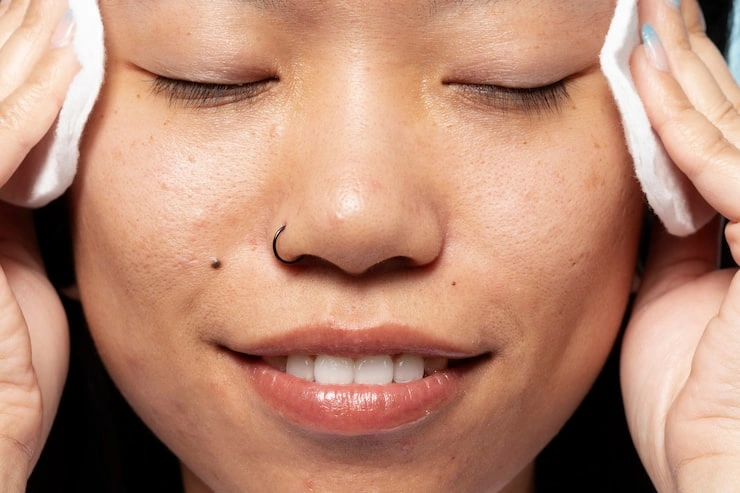
This is where patience comes in. Your sensitive skin did not get this way overnight, and it will not calm down overnight either .
Be consistent with your routine every single day, morning and night. In about a week, you might notice your skin feels less tight after cleansing. It might start to feel softer and more comfortable. The constant low-level irritation may begin to quiet down .
After about four weeks, your skin has gone through a full renewal cycle. This is the time when you should see real changes. The redness should start to fade. Your skin tone and texture should look more even . You should notice fewer breakouts. Your skin will not be completely clear of acne, but the constant battle between sensitivity and breakouts will be improving. The key is to trust the process and not give up .
FAQs
Can I use makeup with this routine?
Yes, you can. Just make sure your skincare products have fully absorbed before you apply makeup. Look for makeup that is labeled non-comedogenic and for sensitive skin .
Should I exfoliate my skin?
Exfoliation is risky for sensitive skin. If you must exfoliate, do it very gently. Use a mild natural exfoliant like oatmeal powder, not a scrub with sharp particles . Do it only once a week and only at night. Over-exfoliation is one of the most common ways to damage your skincare routine for sensitive acne prone skin .
What should I do if my skin reacts badly to a new product?
Stop using the product right away . Rinse your skin with cool water. Go back to your very basic routine with just a gentle cleanser and moisturizer. Use no active ingredients. Let your skin calm down completely. If the irritation is severe, you should talk to a dermatologist .